スズキ エブリィ DA64V
Offset and wheel size calculator
for 12 inch wheels
Applies to: 標準ルーフ・GA, ハイルーフ・PA, ハイルーフ・PC and more (84 variants · 2005/08–2015/02)
Some original sizes are unverified reference values.
Sizes may differ by year and grade. Also check the vehicle's placard and owner's manual. Data sources and licences →
Values shown are the original specifications registered for the new vehicle.They may differ from the sizes currently fitted. Choose the model code, year and grade, and compare with the tyre sidewall, wheel markings and the vehicle's specification.
On vehicles with different front and rear sizes, check the front and rear wheels separately.Don't treat a candidate for one axle as a recommendation for all four wheels. Check the front/rear combination, load capacity and pressure, mounting specification and the product's fitment information.
Frontis being edited. Front and rear settings are retained separately.
Even loaded original values may differ from a modified vehicle. Check the current setup against the actual installed dimensions, and compare staggered front/rear tyres separately.
Original tyre (145R12-6PR) has no marked aspect ratio. Listed outer diameter: 542.0mm, giving an equivalent aspect ratio of 82 is used.
Current wheel and tyre
12×4J / ET45·145/82R12Wheel Spacer 0mm / camber 0°
Wheel
Tyre and spacer
More settings and input options
Camber angle 0.0°
−10° to +10°. Negative angles tilt the top towards the vehicle. A blank input is treated as 0°.
Enter a complete size string
Replacement wheel and tyre
Wheel
Tyre and spacer
More settings and input options
Quick settings and presets
The +1/+2 inch presets choose a tyre with a similar diameter and a wheel whose outer edge stays close to the original position, with less than 10 mm additional inward movement.
Camber angle 0.0°
−10° to +10°. Negative angles tilt the top towards the vehicle. A blank input is treated as 0°.
Enter a complete size string
Calculate offset from a target position
Outer edge unchanged
Inner clearance unchanged
This is movement from the current rim position, not the remaining clearance.Positions are compared at 0° camber. Actual inner clearance is unknown; inspect the vehicle for interference and fitment.
Cross-section
Front: マクファーソンストラット式コイルスプリング
- Current
- Replacement
- Fender
- The wheel and tyre are approximate sections based on the entered dimensions. The vertical dashed line marks the hub mounting face.Suspension drawings are generic references. Brake and knuckle angles follow replacement camber. Drawn gaps do not represent actual clearances or establish fitment.
- Current rim width / offset
- 4 in / +45.0mm
- Replacement rim width / offset
- 4 in / +45.0mm
- Outer rim-edge movement
- Outer edge unchanged
- Inner rim-edge movement
- Inner edge unchanged
- Tyre diameter difference
- ±0.0mm
Rim width describes the tyre-supporting width. Offset is the distance from its centre to the mounting face. Increasing width extends both edges; changing offset shifts the whole assembly. Movement also includes the spacer-thickness difference.
Rim width, offset and worked example
Vehicle side is left; outside is right. The grey dashed line is rim centre and the blue dashed line is the hub mounting face. Rim width is not overall flange-to-flange width. This schematic is not drawn to a constant scale.
Example: from 6 inches / +45 mm to 7 inches / +48 mm, half the width increase is 12.7 mm. The outer edge moves out by 12.7−3 = 9.7 mm; the inner edge moves towards the vehicle by 12.7+3 = 15.7 mm. This hypothetical example has no spacers and 0° camber.
- Ride-height change from tyre diameter
- ±0.0mm
- Change in gap above tyre
- ±0.0mm
Positive values mean higher ride height or a larger gap; negative means lower or smaller. This estimate uses half the diameter difference at 0° camber with unchanged suspension settings, without tyre deflection under load.
Upper-edge position with camber
Upper-edge position with camber
Current 0.0° → replacement 0.0°
- Movement of upper outer point
- ±0.0mm
- Horizontal upper-edge distance to fender
- 20.3mm
- Vertical upper-edge distance to fender
- 30.1mm
This reference rotates the section about the hub centre. Tyre shoulder shape, deflection and suspension movement are excluded. Movement dimensions and the existing fender assessment use 0° camber.
Positive values indicate outward/inward movement as labelled. Values are changes from the current setup.
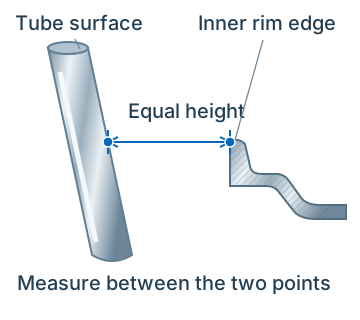
How to measure inner clearance
These fixed explanatory diagrams do not change with the inputs.
The box is shown as a section across the wheel width. The blue line joins the strut-tube surface and inner rim-flange edge at the same height. Inward movement is not remaining clearance.
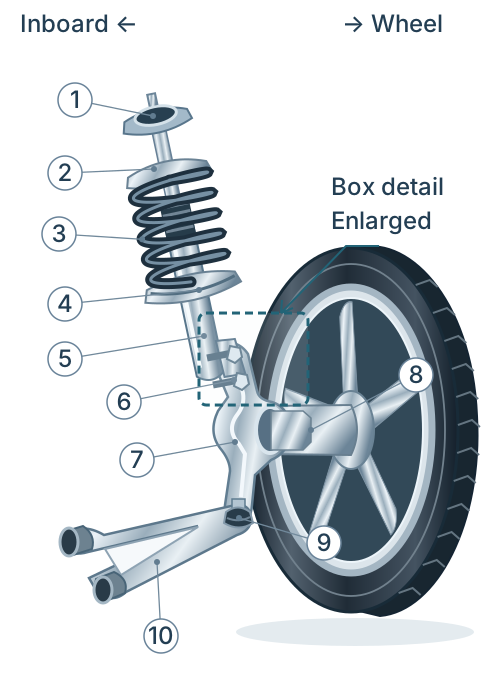
Part legend (10 items)
- Upper mounting point
- Upper spring seat
- Coil spring
- Lower spring seat
- Strut tube
- Strut-to-knuckle joint
- Steering knuckle
- Hub and bearing connection
- Lower ball joint
- Lower control arm
Check tyre-sidewall, spring-seat and spoke-to-caliper clearances separately.
Omitted parts and physical checks
This typical strut schematic does not reproduce actual dimensions or establish fitment. Brakes, driveshaft, tie rod, anti-roll bar and mounting brackets are omitted but also require clearance checks. Clearance changes with ride height, steering and load. Part numbers are legend references, not measurement points.
Fender positionAssessment uses a position estimated from the original size
Fender calculations use the nominal wheel-size reference. This differs from the physical rim edge; do not enter an edge measurement without checking the reference.
If a value is unknown, keep the estimate as a reference. An estimate does not establish fitment.
Estimate assumptions
From the outside of the current (original) tyre: 20mm outwards and above the upper edge by 30mm above the reference point. This is a common assumption, not a vehicle measurement.
Choose Clear fender position to disable the assessment.
View reference points and measurement locations
These fixed explanatory diagrams do not change with the inputs.
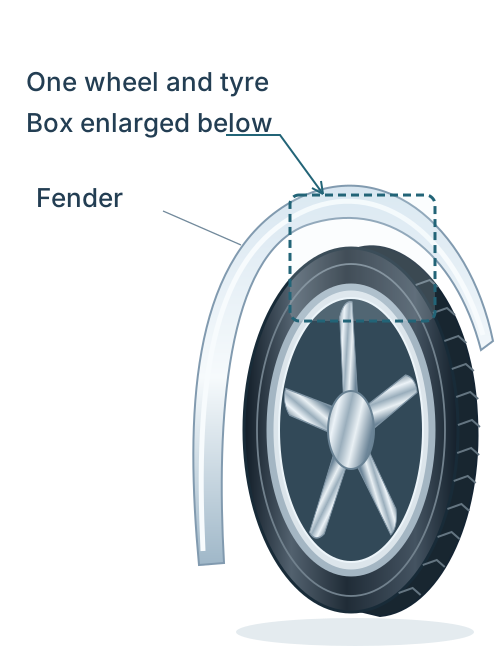
An enlarged section cuts across the wheel width. It is not simply a zoom of the same viewing angle.
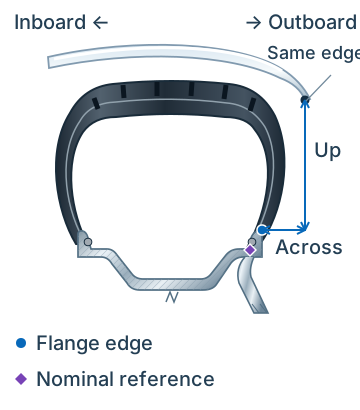
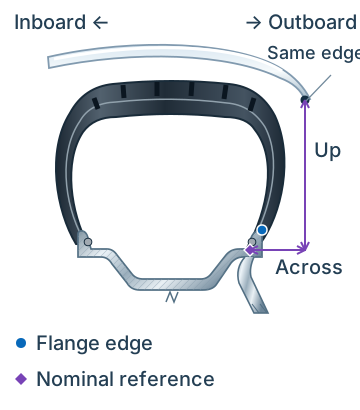
Use the distance from the purple reference. The vertical distance is between stationary points, not remaining tyre clearance while driving.
Nominal dimensions and measurement corrections
Nominal rim width is normally measured between bead seats, and nominal diameter at the tyre seat. These references can be difficult to measure on an installed wheel. Any correction from a physical edge requires product dimensions or a measured basis. No universal correction or automatic conversion is applied.
Compare candidates A, B and C Front·0/3
Keep up to three replacement candidates per axle during this page visit. Reloading or changing vehicle/specification clears them; they are not included in shared URLs or restored inputs. Use Save in My garage to keep a setup.
Candidates are recalculated against the current setup. Movement is the rim-edge difference at 0° camber, not a determination of physical clearance or fitment.
-
CandidateA
No saved comparison candidates yet.
-
CandidateB
No saved comparison candidates yet.
-
CandidateC
No saved comparison candidates yet.
Detailed results and fender assessmentDiameter, circumference, calculated speed and fender margins
Wheel position changes
- Outside (outer rim edge)
- ±0.0mm
- Outer edge unchanged
- Inside (inner rim edge)
- ±0.0mm
- Inner edge unchanged
Outer tyre sidewall ±0.0mm / inner ±0.0mm
Fender
OK- Lateral wheel margin
- 42.0mm
- Lateral tyre margin
- 20.3mm
- Difference at tyre top
- 30.1mm
Tyre diameter and speedometer
- Diameter difference
- ±0.0mm
- ±0.0%
- At an indicated 100 km/h
- 100.0km/h
- Calculated road speed
| Diameter | Circumference | Sidewall | |
|---|---|---|---|
| Current 145/82R12 | 542.6mm | 1,704.6mm | 118.9mm |
| Replacement 145/82R12 | 542.6mm | 1,704.6mm | 118.9mm |
| Indicated speed | Calculated road speed | Difference |
|---|---|---|
| 40km/h | 40.0km/h | ±0.0km/h |
| 60km/h | 60.0km/h | ±0.0km/h |
| 80km/h | 80.0km/h | ±0.0km/h |
| 100km/h | 100.0km/h | ±0.0km/h |
This assumes the speedometer is accurate with the original tyres.
Related calculations with this original size
The registered grade and front/rear original sizes are carried over. Check the sizes actually fitted and which wheels are driven. Where gear ratios or the final drive ratio are not registered, replace the example values in the calculator with your vehicle's figures.
Applies to: 標準ルーフ・GA (2WD, 5MT) 2014/04–2015/02. With different front and rear sizes, speed and rpm calculations use the tyre diameter on the driven axle. For four-wheel-drive vehicles, also check the manufacturer's limits on front/rear circumference difference.
FITMENT
Requirements for aftermarket wheels
- PCD and studs
- 4H-100
- Centre bore
- 60mm or larger
Only wheels with the same PCD and stud count will fit. If a wheel has a larger centre bore, filling the gap with a hub ring helps prevent vibration.
INCH UP
Plus-size options
Sizes with a diameter close to the original 145R12-6PR. Tap Calculate to load one into the calculator above and check the protrusion.
13 inch
-
175/60R13
Diameter −1.8mm · Rim Width 5–6J
-
165/65R13
Diameter +2.7mm · Rim Width 4.5–6J
-
135/80R13
Diameter +4.2mm · Rim Width 3.5–5J
14 inch
-
155/60R14
Diameter −0.4mm · Rim Width 4.5–5.5J
-
145/65R14
Diameter +2.1mm · Rim Width 4–5J
-
135/70R14
Diameter +2.6mm · Rim Width 3.5–5J
REFERENCE
Reference figures for this vehicle
- Track front / rear
- 1,300mm / 1,290mm
- Width
- 1,475mm
- Vehicle weight
- 870–980kg
- Max. power
- 49–64PS
- Min. turning radius
- 4.1m
- Suspension front / rear
- マクファーソンストラット式コイルスプリング / I.T.L.(アイソレーテッド・トレーリング・リンク)式コイルスプリング
- Brakes front / rear
- ディスク / ドラム(リーディングトレーディング)
Vehicle weight is a guide for the tyre load index; track width is a guide for side-to-side protrusion.
BY GRADE
Grades with this original size
84 variants
- 標準ルーフ・GA (2WD, 5MT)2014/04–2015/02
- 標準ルーフ・GA (2WD, 3AT)2014/04–2015/02
- ハイルーフ・PA (2WD, 5MT)2014/04–2015/02
- ハイルーフ・PA (2WD, 3AT)2014/04–2015/02
- ハイルーフ・PC (2WD, 5MT)2014/04–2015/02
- ハイルーフ・PC (2WD, 3AT)2014/04–2015/02
- ハイルーフ・JOIN (2WD, 5MT)2014/04–2015/02
- ハイルーフ・JOIN (2WD, 3AT)2014/04–2015/02
- ハイルーフ・JOIN ターボ (2WD, 5MT)2014/04–2015/02
- ハイルーフ・JOIN ターボ (2WD, 4AT)2014/04–2015/02
- 標準ルーフ・GA (4WD, 5MT)2014/04–2015/02
- ハイルーフ・PA (4WD, 5MT)2014/04–2015/02
- ハイルーフ・PA (4WD, 3AT)2014/04–2015/02
- ハイルーフ・PC (4WD, 5MT)2014/04–2015/02
- ハイルーフ・PC (4WD, 3AT)2014/04–2015/02
- ハイルーフ・JOIN (4WD, 5MT)2014/04–2015/02
- ハイルーフ・JOIN (4WD, 3AT)2014/04–2015/02
- ハイルーフ・JOIN ターボ (4WD, 5MT)2014/04–2015/02
- ハイルーフ・JOIN ターボ (4WD, 4AT)2014/04–2015/02
- 標準ルーフ・GA (2WD, 5MT)2013/04–2014/04
- 標準ルーフ・GA (2WD, 3AT)2013/04–2014/04
- ハイルーフ・PA (2WD, 5MT)2013/04–2014/04
- ハイルーフ・PA (2WD, 3AT)2013/04–2014/04
- ハイルーフ・PC (2WD, 5MT)2013/04–2014/04
- ハイルーフ・PC (2WD, 3AT)2013/04–2014/04
- ハイルーフ・JOIN (2WD, 5MT)2013/04–2014/04
- ハイルーフ・JOIN (2WD, 3AT)2013/04–2014/04
- ハイルーフ・JOIN ターボ (2WD, 5MT)2013/04–2014/04
- ハイルーフ・JOIN ターボ (2WD, 4AT)2013/04–2014/04
- 標準ルーフ・GA (4WD, 5MT)2013/04–2014/04
- ハイルーフ・PA (4WD, 5MT)2013/04–2014/04
- ハイルーフ・PA (4WD, 3AT)2013/04–2014/04
- ハイルーフ・PC (4WD, 5MT)2013/04–2014/04
- ハイルーフ・PC (4WD, 3AT)2013/04–2014/04
- ハイルーフ・JOIN (4WD, 5MT)2013/04–2014/04
- ハイルーフ・JOIN (4WD, 3AT)2013/04–2014/04
- ハイルーフ・JOIN ターボ (4WD, 5MT)2013/04–2014/04
- ハイルーフ・JOIN ターボ (4WD, 4AT)2013/04–2014/04
- 標準ルーフ・GA (2WD, 5MT)2010/05–2013/04
- 標準ルーフ・GA (2WD, 3AT)2010/05–2013/04
- ハイルーフ・PA (2WD, 5MT)2010/05–2013/04
- ハイルーフ・PA (2WD, 3AT)2010/05–2013/04
- ハイルーフ・PU (2WD, 5MT)2010/05–2013/04
- ハイルーフ・PU (2WD, 3AT)2010/05–2013/04
- ハイルーフ・PC (2WD, 5MT)2010/05–2013/04
- ハイルーフ・PC (2WD, 3AT)2010/05–2013/04
- ハイルーフ・JOIN (2WD, 5MT)2010/05–2013/04
- ハイルーフ・JOIN (2WD, 3AT)2010/05–2013/04
- ハイルーフ・JOIN ターボ (2WD, 5MT)2010/05–2013/04
- ハイルーフ・JOIN ターボ (2WD, 4AT)2010/05–2013/04
- 標準ルーフ・GA (4WD, 5MT)2010/05–2013/04
- ハイルーフ・PA (4WD, 5MT)2010/05–2013/04
- ハイルーフ・PA (4WD, 3AT)2010/05–2013/04
- ハイルーフ・PU (4WD, 5MT)2010/05–2013/04
- ハイルーフ・PU (4WD, 3AT)2010/05–2013/04
- ハイルーフ・PC (4WD, 5MT)2010/05–2013/04
- ハイルーフ・PC (4WD, 3AT)2010/05–2013/04
- ハイルーフ・JOIN (4WD, 5MT)2010/05–2013/04
- ハイルーフ・JOIN (4WD, 3AT)2010/05–2013/04
- ハイルーフ・JOIN ターボ (4WD, 5MT)2010/05–2013/04
- ハイルーフ・JOIN ターボ (4WD, 4AT)2010/05–2013/04
- 標準ルーフ・GA (2WD, 5MT)2005/08–2010/05
- 標準ルーフ・GA (2WD, 3AT)2005/08–2010/05
- ハイルーフ・PA (2WD, 5MT)2005/08–2010/05
- ハイルーフ・PA (2WD, 3AT)2005/08–2010/05
- ハイルーフ・PU (2WD, 5MT)2005/08–2010/05
- ハイルーフ・PU (2WD, 3AT)2005/08–2010/05
- ハイルーフ・PC (2WD, 5MT)2005/08–2010/05
- ハイルーフ・PC (2WD, 3AT)2005/08–2010/05
- ハイルーフ・JOIN (2WD, 5MT)2005/08–2010/05
- ハイルーフ・JOIN (2WD, 3AT)2005/08–2010/05
- ハイルーフ・JOIN ターボ (2WD, 5MT)2005/08–2010/05
- ハイルーフ・JOIN ターボ (2WD, 4AT)2005/08–2010/05
- 標準ルーフ・GA (4WD, 5MT)2005/08–2010/05
- ハイルーフ・PA (4WD, 5MT)2005/08–2010/05
- ハイルーフ・PA (4WD, 3AT)2005/08–2010/05
- ハイルーフ・PU (4WD, 5MT)2005/08–2010/05
- ハイルーフ・PU (4WD, 3AT)2005/08–2010/05
- ハイルーフ・PC (4WD, 5MT)2005/08–2010/05
- ハイルーフ・PC (4WD, 3AT)2005/08–2010/05
- ハイルーフ・JOIN (4WD, 5MT)2005/08–2010/05
- ハイルーフ・JOIN (4WD, 3AT)2005/08–2010/05
- ハイルーフ・JOIN ターボ (4WD, 5MT)2005/08–2010/05
- ハイルーフ・JOIN ターボ (4WD, 4AT)2005/08–2010/05
FAQ
FAQ: cars with 12 inch wheels
Tap a question to show the answer.
What is the original offset for the エブリィ (DA64V) with 12 inch wheels?
The original 12x4J +45 wheel has an offset of +45. In Japan, offset is now officially called “inset”. Reducing the offset by 1 moves the wheel 1 mm outwards (with the same rim width).
How far can the エブリィ (DA64V) with 12 inch wheels go up in wheel size?
To keep the diameter close to the original (145R12-6PR), guide sizes are 13 inch: 175/60R13, 14 inch: 155/60R14. Whether they actually fit depends on rim width, offset and fender clearance. Check the protrusion with the calculator on this page.
How do I get a flush fitment on the エブリィ (DA64V) with 12 inch wheels?
Measure the lateral gap between the fender lip and the outside of the tyre, then choose a rim width and offset that move the wheel out by that amount. If you have not measured it, the calculator on this page checks against a fender position estimated from the original size (the estimate errs on the safe side).
Which aftermarket wheels fit the エブリィ (DA64V) with 12 inch wheels?
Wheels with a 4H-100 PCD and stud count and a centre bore of 60mm or larger. If the wheel's centre bore is larger, filling the gap with a hub ring helps prevent vibration.